
Range Hedging Trading Strategy
1. What is Range Hedging?
The Range Hedging strategy is designed for range-bound markets, where price oscillates between a defined support and resistance zone. The bot opens positions inside a price range and uses hedging orders to protect against temporary breakouts.
- Optimized for sideways and consolidating markets
- Combines range trading with hedging protection
- Reduces drawdown during false breakouts
2. Creating a New Range Hedging Bot

- 1. Log in to your FX eTrader account
- 2. Click on “Create New Bot”
- 3. Select Hedging → Range Hedging
- 4. Configure the parameters described below
3. Step (1): Primary Orders Configuration
This step defines how the bot configures and manages the Primary Orders, which represent the main trading positions of the Range Hedging strategy.
Primary orders are opened exclusively based on the signals defined in Step 3: Rules for Primary Orders. These rules determine when and in which direction the bot is allowed to enter the market.
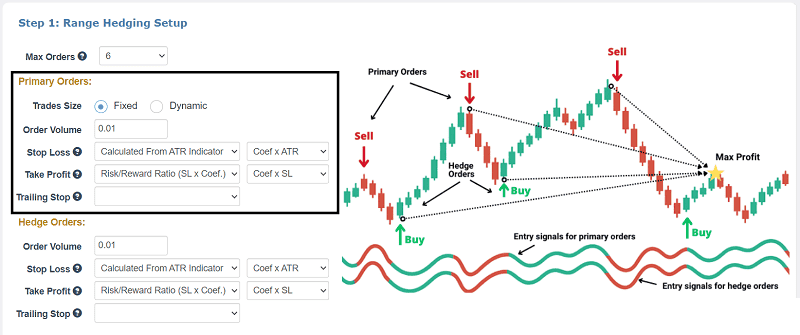
3.1 Primary Orders: Trades Size
Select whether the trade volume is Fixed (same volume on every trade) or Dynamic (volume based on risk percentage of account balance).
3.2 Order Volume / Risk Per Order
If using Fixed sizing, set the exact trade volume. If using Dynamic, choose the risk percentage per order (e.g., 0.25 %, 0.5 %, etc.). :contentReference[oaicite:3]{index=3}
3.3 Stop Loss Settings
Define how the Stop Loss for the primary trend trade is calculated:
- Calculated From ATR Indicator: Based on market volatility.
- Fixed Distance: Set pip distance manually.
- Fractal High/Low: Uses the most recent fractal extremes.
3.4 Take Profit Settings
Choose how the Take Profit target is defined:
- Risk/Reward Ratio: Target based on a multiple of Stop Loss.
- Calculated From ATR: Based on market volatility.
- Fixed Distance: Specific pip target.
3.5 Trailing Stop
If enabled, the trailing stop will follow price movement to lock in profits. Options include:
- Fixed Distance in pips
- Fractal High/Low
- Breakeven
Also set the percentage at which the trailing stop becomes active (25 %, 50 %, 75 %).
4. Step (2): Hedge Orders Configuration
This step defines how the bot configures and manages the Hedge Orders, which are protective trades designed to reduce risk when price moves against the primary positions.
Hedge orders are opened exclusively based on the signals defined in Step 4: Rules for Hedge Orders. These rules determine when hedging is activated and how the bot reacts to adverse or breakout price movements.
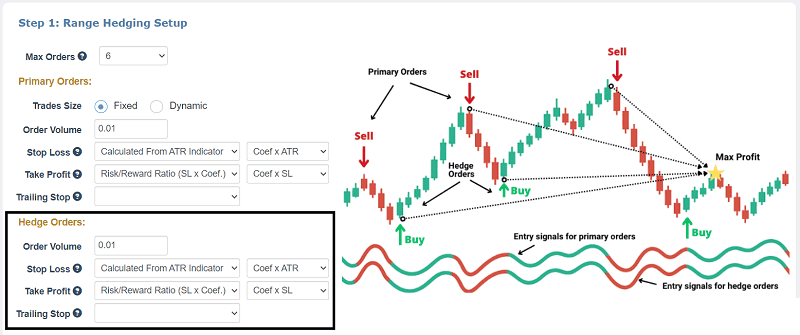
4.1 Max Orders
Set how many hedge orders the bot can open (e.g., 1–20). More hedge orders provide greater coverage during pullbacks but increase potential exposure.
4.2 Order Volume & Risk Per Order
Configure hedge order sizes and the risk percentage per hedge entry. Larger hedge sizes can recover drawdowns faster but carry more risk.
4.3 Hedge Stop Loss and Take Profit
Define stop loss and take profit for hedge trades using the same calculation options as the primary trade (ATR-based, Risk/Reward, or Fixed Distance).
4.4 Hedge Trailing Stop
Optional trailing stop settings for hedge orders to lock in profit as price reverses back toward the trend.
5. Step (3): Trade Management
5.1 Close All Trades at Max Profit
Automatically closes all open positions when the cumulative profit reaches the defined value.
5.2 Global Stop Loss
Defines the maximum acceptable loss for all open trades combined.
5.3 Daily Profit & Loss Limits
- Max Profit Daily: Stops trading after reaching the daily profit target
- Max Loss Daily: Stops trading after reaching the daily loss limit

6. Step (4): Defining Entry and Exit Signal Rules for Primary and Hedging Orders
This section defines how the bot enters the market and how it reacts to trend changes.
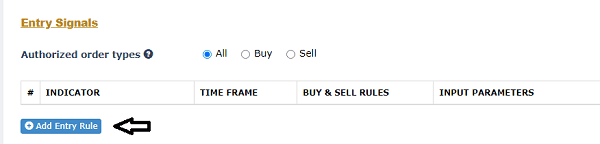
6.1 Entry Signals
Select one or more technical indicators that will trigger the opening of the primary trend-following trade. These signals determine when market conditions are favorable for entering a position.
- Moving Average crossover
- RSI overbought / oversold levels
- MACD signal confirmation
- ...

6.2 Trend Filter (Optional)
The trend filter ensures that trades are only opened in the direction of the dominant market trend. This significantly improves trade quality and reduces false signals.
- Only Buy in Uptrend
- Only Sell in Downtrend
- Ignore signals against the trend
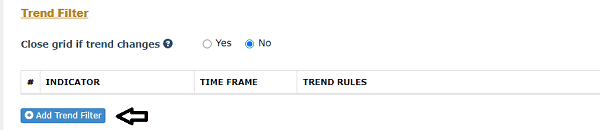
6.3 Close Orders on Trend Change
When enabled, all open trades (primary and hedge positions) will be closed automatically if the trend direction changes. This feature protects your capital against strong market reversals.
6.4 Exit Rules (Optional)
Exit Rules allow you to define trade exit conditions using technical indicators, in addition to the default take profit and stop loss settings.
These optional rules enable you to set custom exit logic for each trade. When an exit signal is triggered, the bot closes only profitable trades, meaning trades with a positive profit, while leaving losing trades open.
This approach provides greater control over trade exits and can help maximize profits while improving overall position management.

These optional exit rules add flexibility to the Trend-Following Hedging strategy and help improve risk control, especially during periods of reduced volatility or uncertain trend conditions.
7. Generating and Installing Your Bot
- Click “Build the Bot” to generate the EA
- Download the EA file (.ex4 / .ex5)
- Install it in MetaTrader: File → Open Data Folder → MQL4/MQL5 → Experts
- Restart MetaTrader and enable automated trading